
Choosing a smart lock for a project in Saudi Arabia is not only about deciding between fingerprint, PIN code, RFID card or mobile app access. The installation environment, door construction, operating model and long-term maintenance requirements can be just as important as the unlocking method.
Saudi Arabia has a predominantly semi-arid to arid desert climate. According to the Saudi National Center for Meteorology, typical maximum temperatures across the Kingdom range from about 35–45°C during summer, and the country also shows clear differences between coastal and inland climate conditions. The National Center for Meteorology also operates a regional center dedicated to monitoring sand and dust storms. These conditions do not mean every smart lock in Saudi Arabia needs the same specification, but they do mean project buyers should evaluate where and how each lock will actually be installed.
An RFID hotel lock installed inside an air-conditioned corridor in Riyadh has very different requirements from a villa entrance exposed to direct sunlight, or a resort room close to the Red Sea where humidity and corrosion resistance may matter more. For B2B buyers, the correct approach is to match the product to the real installation environment rather than selecting one lock specification for every door.
This guide is intended for hotel owners, developers, contractors, distributors, system integrators and project buyers evaluating Saudi Arabia project supply for hotels, resorts, serviced apartments, residential buildings and villas.
1. Why Smart Lock Selection Is Different in Saudi Arabia
Saudi projects cover very different operating environments. A hotel guest-room door, a serviced-apartment entrance, a private villa gate and a coastal resort room should not automatically use the same smart lock configuration.
Before choosing a model, classify the installation using four basic questions:
- Indoor, semi-outdoor or outdoor? A protected interior door normally has lower environmental exposure than a villa or resort entrance.
- Direct sunlight or shaded? Solar exposure can significantly increase the surface temperature of the exterior panel.
- Inland or coastal? Coastal projects can place more emphasis on humidity and corrosion resistance.
- Hospitality or residential operation? A hotel normally needs centralized card management, while a villa may prioritize fingerprint, PIN and app access.
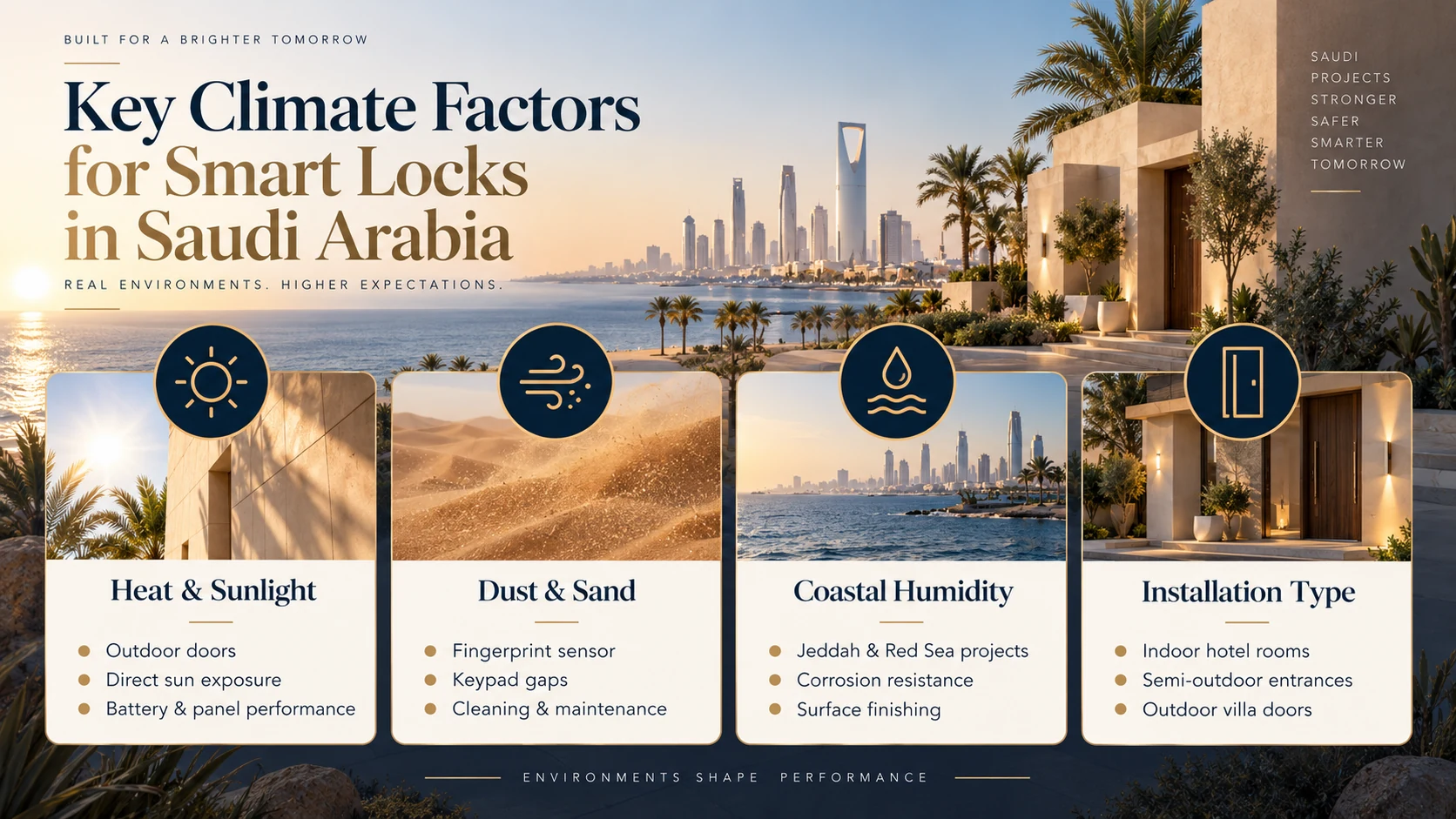
This classification is useful because it avoids two common mistakes: over-specifying indoor doors and under-specifying locks that are exposed to outdoor conditions.
2. Heat and Direct Sunlight
Heat is an important consideration, but it should not be treated as a blanket requirement for every Saudi project. The Saudi National Center for Meteorology reports summer maximum temperatures generally in the 35–45°C range across the Kingdom. In specific hot-weather periods and locations, temperatures can be higher. What matters for a smart lock project is how much of that heat reaches the installed product.
Indoor hotel guest rooms
For a hotel-room lock located inside an air-conditioned corridor, environmental heat is usually less important than system stability, mechanical durability, battery performance, card management and spare-parts availability. The lock is protected from direct sunlight and major temperature swings.
Outdoor and semi-outdoor doors
Villa entrances, resort doors, low-rise apartment entrances and service doors can face stronger environmental exposure. A dark lock panel in direct sunlight can become hotter than the surrounding air, so buyers should ask for the actual operating-temperature specification instead of relying on a general statement such as “suitable for hot climates.”
For exposed doors, confirm:
- The specified operating-temperature range of the exact model.
- Whether the front panel is recommended for direct sunlight.
- The front-panel material and surface treatment.
- Touchscreen or keypad behavior at elevated surface temperature.
- The recommended battery type and replacement interval.
- Whether an architectural canopy or shaded entrance can reduce exposure.
Project tip: If the lock will face afternoon sun every day, tell the supplier before selecting the sample. “Outdoor” and “outdoor with prolonged direct solar exposure” are not always the same requirement.
3. Dust and Sand Exposure
Saudi Arabia maintains a dedicated Regional Center for Dust and Sand Storms, and dust remains a real environmental factor even though intensity varies by region and season. For smart locks, the issue is not only major dust storms. Fine dust can also accumulate gradually around exposed interfaces and mechanical openings.
Areas that may require attention include:
- Fingerprint sensor windows.
- Touchscreen and keypad edges.
- Emergency mechanical key cylinders.
- Handle pivots and moving parts.
- Latch and mortise openings.
- Battery-cover gaps.
Fingerprint access in dusty locations
Fingerprint access can still be suitable for Saudi villas and residential projects, but the sensor surface should be easy to clean and should not be positioned where it constantly collects dust. For some exposed applications, PIN or RFID access can provide a useful alternative credential when the sensor needs cleaning.
Do not assume an IP rating
If the project specification requires a particular ingress-protection rating, request the test information for the exact product model. Do not assume that a lock is IP65 or IP66 simply because it is marketed for outdoor use. For B2B projects, verified product data is more valuable than generic “waterproof” or “dustproof” language.
4. Coastal and Humid Areas: Jeddah, Red Sea and Gulf Projects
Saudi Arabia has meaningful differences between inland and coastal climate conditions. Saudipedia notes that humidity increases toward the Red Sea and Arabian Gulf coasts. This makes coastal projects different from dry inland projects when evaluating materials and long-term corrosion risk.
For projects in or near Jeddah, the Red Sea coast, Dammam and other coastal areas, buyers should pay closer attention to:
- Front and rear panel materials.
- Surface coating or finishing process.
- Exposed screws and fasteners.
- Mortise and latch materials.
- Battery contacts and internal connectors.
- Protection of internal electronics.
A lock that is appropriate for an indoor Riyadh apartment may not need the same corrosion-oriented specification as a semi-outdoor resort door near the Red Sea. For coastal projects, tell the supplier the city and whether the door is indoor, shaded, semi-outdoor or directly exposed.
5. Smart Locks for Saudi Hotel Projects
For hotels, resorts and many managed hospitality properties, hotel smart lock solutions with an RFID hotel lock system remain a practical choice because the project needs centralized credential management rather than simply a standalone door lock.
A complete hotel lock solution can include:
- hotel RFID locks.
- Hotel lock management software.
- Card encoder.
- Guest cards, staff cards and management cards.
- Optional energy-saving switches and related accessories.
RFID frequency and existing hotel systems
If the property already has key cards, energy-saving switches or other card-based systems, the project team should confirm card frequency and compatibility before selecting the lock. This is particularly important for hotel renovation and replacement projects.
PMS integration
If the hotel wants the lock system to work with its Property Management System, confirm the integration requirement before ordering. The hotel’s PMS vendor or IT team may need interface documentation or API information from the lock-system supplier. Integration should be treated as a technical project requirement, not assumed from the presence of hotel lock software alone.
New hotel vs replacement project
For a new hotel, the door and mortise can often be planned around the selected lock. For a replacement project, existing door preparation matters much more. The buyer should provide photos and mortise dimensions so the supplier can evaluate whether the existing opening can be reused or modified with minimal work.
6. Smart Locks for Villas in Saudi Arabia
Villa projects usually need a different user experience from hotels. Residents may prefer multiple access methods on one lock, for example fingerprint + PIN + RFID card + app + mechanical key.
Typical villa priorities include:
- Fast everyday access for family members.
- Temporary or controlled access for guests and service staff.
- A design that matches the entrance door.
- Suitable performance for the actual outdoor or semi-outdoor environment.
- Emergency mechanical access and low-battery warning.
For a villa entrance, send the supplier photos showing the complete door, the lock edge and the existing lock body. Also indicate whether the door is exposed to direct sunlight or protected by a canopy.
7. Smart Locks for Apartments and Serviced Apartments
Apartment projects in Saudi Arabia can be owner-occupied, long-term rental, serviced residential or hospitality-like. The operating model should influence the lock choice.
Residential apartments often prioritize fingerprint, PIN and app convenience. Serviced apartments may place more importance on temporary credentials, centralized management or easier turnover between guests. Managed buildings may also need different permissions for residents, maintenance teams and property managers.
Before selecting TTLock, Tuya or another app-managed solution, confirm whether remote functions require a gateway, what administrator permissions are available and how access will be transferred when occupants change.
8. Indoor vs Outdoor Smart Locks
The easiest way to avoid specification mistakes is to separate indoor and exposed applications before model selection.
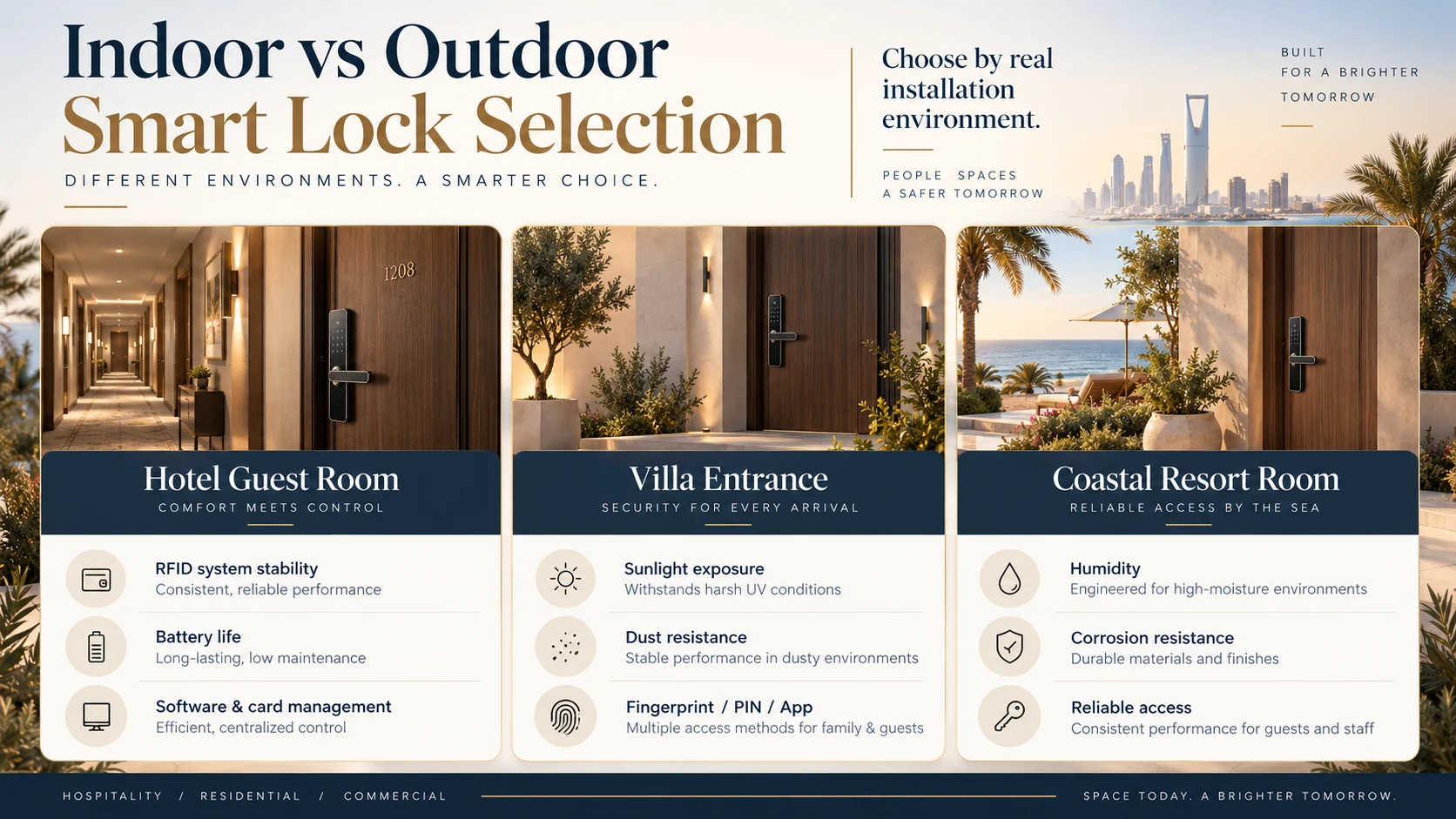
| Application | Main Priority | Environmental Focus |
|---|---|---|
| Indoor hotel guest room | RFID system stability, battery life, software | Usually limited environmental exposure |
| Hotel or resort exterior room | Reliable guest access and system management | Heat, dust, humidity depending on location |
| Villa entrance | Fingerprint / PIN / RFID / app convenience | Sunlight, heat and dust may be significant |
| Apartment unit door | Residential convenience and door fit | Depends on corridor or outdoor exposure |
| Coastal resort or villa | Reliable access and durable hardware | Humidity and corrosion resistance |
9. Door and Mortise Compatibility
A smart lock can have the right software and access methods but still be unsuitable if it does not fit the door. Door compatibility should be checked before a sample is ordered whenever possible.
Confirm:
- Door material: wood, steel, aluminum or another construction.
- Door thickness.
- Existing mortise or lock-body dimensions.
- Backset and center distance where applicable.
- Door opening direction.
- Whether the door is a new installation or retrofit.
For replacement projects, clear photos with a ruler or dimension drawing are especially useful. This can reduce the risk of selecting a model that requires excessive cutting or modification during installation.
10. What Saudi Buyers Should Send Before Quotation
A useful project quotation needs more than a quantity. The supplier should understand the application well enough to recommend the correct lock body, access method and environmental configuration.
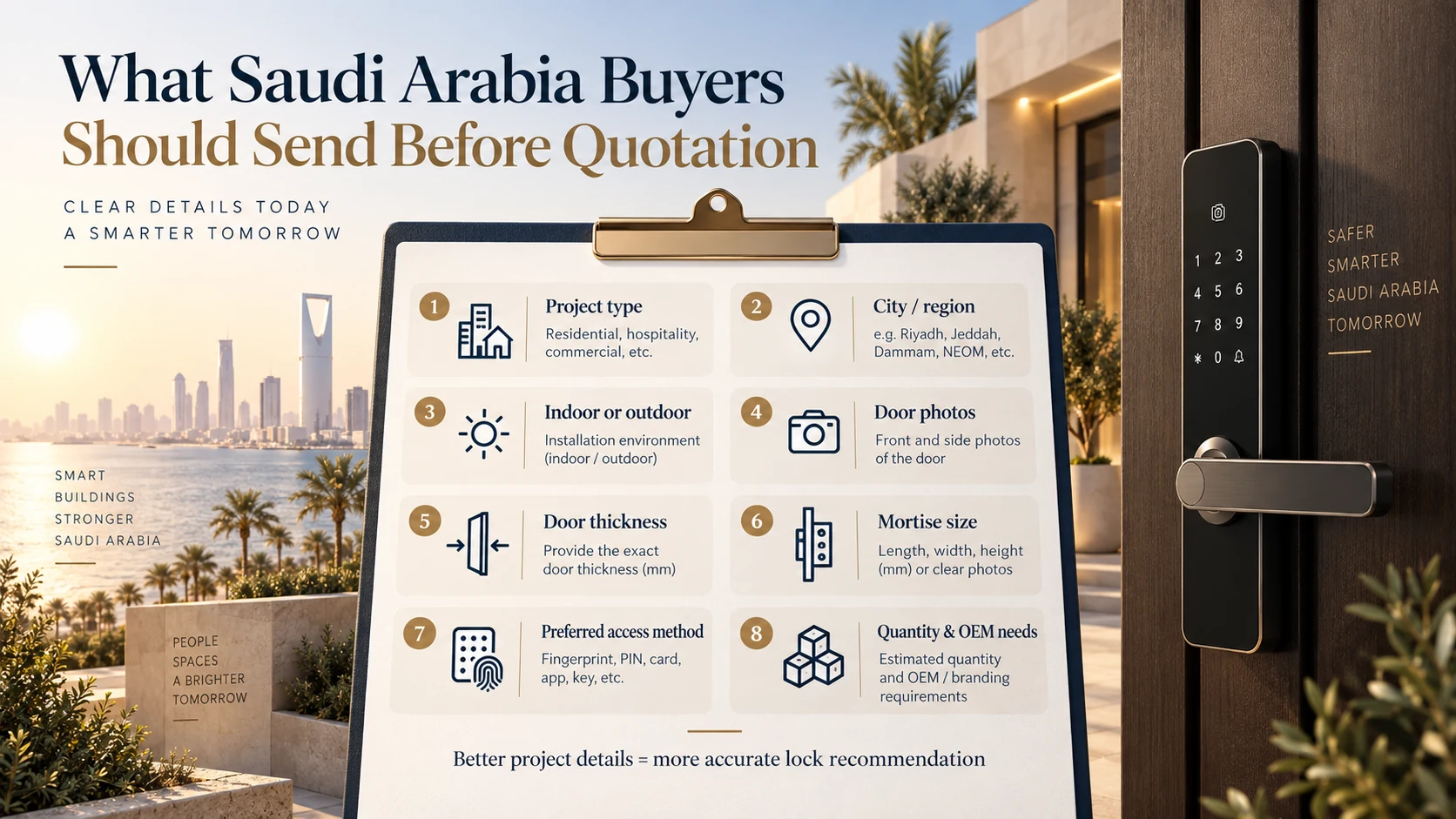
Send the following information:
- Project type: hotel, resort, serviced apartment, residential building or villa.
- City or region: for example Riyadh, Jeddah or Dammam.
- Installation environment: indoor, semi-outdoor or outdoor.
- Door photos: front, side/edge and existing lock area.
- Door thickness: exact measurement in millimeters.
- Mortise dimensions: drawing, dimensions or clear photos.
- Preferred access method: fingerprint, PIN, RFID card, app or combination.
- Quantity: sample quantity and expected project quantity.
- OEM requirements: logo, packaging or other branding needs.
- System requirements: hotel software, encoder, PMS integration, TTLock, Tuya or other requested platform.
11. Questions to Ask Your Smart Lock Supplier
Before confirming the order, ask practical questions that relate directly to the project:
- Is this exact model recommended for indoor, semi-outdoor or outdoor use?
- What is the specified operating-temperature range?
- Has the model been tested to any IP rating, and can the documentation be provided?
- What mortise options are available?
- Can the lock fit the existing door preparation?
- For hotel projects, what software, encoder and card system are included?
- Is PMS integration supported, and what interface information is available?
- Can samples be supplied before mass production?
- What spare parts should be included with a project order?
- What OEM options are available for logo and packaging?
These questions are more useful than asking only for “the best lock for Saudi Arabia,” because the correct product depends on the door, location, operating model and project environment.
Frequently Asked Questions
For many hotels, an RFID hotel lock system is a practical solution because it supports guest cards, staff permissions and centralized room management. The exact model should still be selected according to the door specification and whether the entrance is indoor or exposed.
Yes. Fingerprint locks can be suitable for villas and residential apartments. For exterior entrances, confirm the operating environment, direct-sun exposure and maintenance requirements before selecting the model.
No. Indoor hotel rooms and interior apartment doors may not require the same ingress protection as exposed outdoor doors. If a project specification requires an IP rating, request verified information for the exact model rather than assuming a rating.
Coastal areas generally have higher humidity than inland areas, so material selection, surface finishing and corrosion resistance deserve more attention for exposed coastal installations.
Send the project type, city, installation environment, door photos, door thickness, mortise information, access-method requirement and quantity. For hotel projects, also state whether hotel software, encoder, RFID cards or PMS integration are required.
OEM options can include logo, packaging and product configuration depending on the selected model and order quantity. Project requirements should be confirmed before production.
Conclusion
Choosing a smart lock for Saudi Arabia should begin with the project environment, not only the feature list. Indoor hotel locks, outdoor villa entrances and coastal resort doors have different priorities. Heat, sunlight, dust, humidity, access management and door compatibility should be evaluated together.
For hotel projects, the complete RFID system—including lock software, encoder, cards and possible PMS integration—should be considered early. For villas and apartments, the focus may shift toward fingerprint, PIN and app convenience, while exposed entrances need additional attention to environmental suitability.
Planning a smart lock project in Saudi Arabia? SmartLockOne supplies hotel RFID lock systems, apartment smart locks and villa smart lock solutions for GCC distributors, contractors and project buyers. Send us your project city, door photos, door thickness, installation environment, preferred access method and quantity, and we can help identify a suitable configuration.