
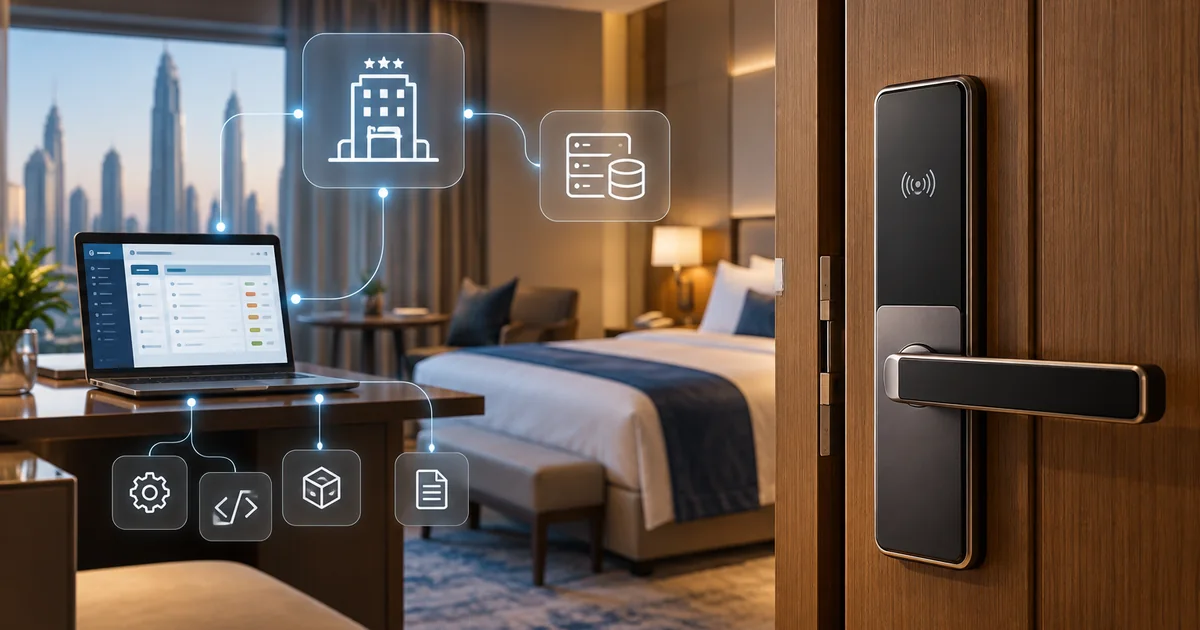
Hotels upgrading their door-lock systems often want to preserve a property management system (PMS) or hotel software platform that staff already know. The key procurement question is not simply whether the new locks use RFID cards. It is how the hotel’s existing workflows, lock management software and guest access credentials will work together.
SmartLockOne supplies hotel lock systems and can provide hotel lock management software. For projects that need to connect an existing hotel software platform or PMS, SmartLockOne supports PMS integration and can provide API, SDK and DLL interface materials to the customer’s technical team. The exact approach is agreed for each software environment and project configuration.
This guide explains the role of the different integration tools, the questions an IT team should ask, a practical implementation sequence and the information to share when requesting an integration proposal.
What PMS integration means for a hotel lock project
A PMS manages hotel operations such as reservations, room assignments and guest stays. A hotel lock management system handles functions related to guest-room access, credentials and staff permissions. Integration is the planned exchange of the information or actions needed to align these workflows.
For example, a hotel might want front-desk staff to issue a guest credential as part of check-in, change the assigned room, control the credential validity period or manage a lost card. These are common business requirements; they should not be taken as a promise that every operation is already supported by every lock model, PMS or interface version.
It is useful to separate three decisions: whether the hotel needs SmartLockOne’s own lock management software, which actions should be connected to its existing PMS, and how the hardware, card encoder and on-site workflow will be configured. The hotel lock solution should be reviewed as a complete system rather than as a lock-only purchase.
The system components involved
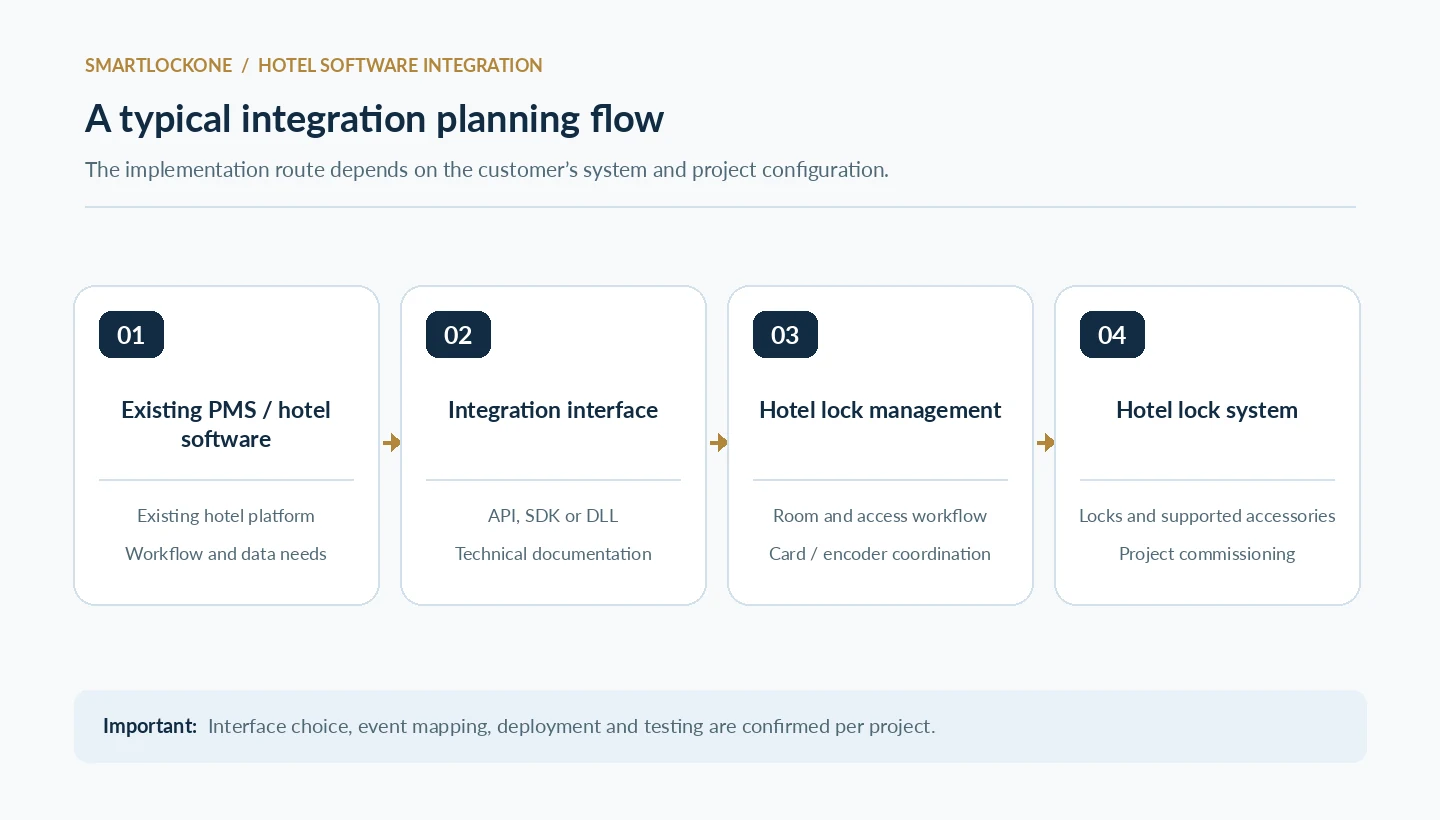
A hotel integration project typically spans four functional areas:
- Existing PMS or hotel software: the platform that contains the hotel’s reservations, room and operational information.
- Integration interface: an available API, SDK or DLL, together with its documentation and the software that connects the two environments.
- Hotel lock management software: tools used to manage the selected lock system’s access and credential workflow.
- Door hardware and accessories: selected hotel locks, compatible cards and encoders, and other project components where required.
Some hotels need a simple check-in workflow, while others require several buildings, staff roles or integration with an existing property technology stack. Hardware compatibility and software integration are related, but separate checks. A software interface alone cannot resolve an incompatible mortise, door preparation or card credential type.
API, SDK and DLL: what is the difference?
API: a defined way for software systems to exchange actions or data
An application programming interface (API) describes how software can request supported operations and receive responses. For a hotel project, this can be part of a connector between an existing PMS and the selected hotel lock management environment. The particular requests, responses, authentication method and interface version must be taken from the documentation provided for the project.
SDK: a toolkit to support integration development
A software development kit (SDK) typically packages development resources such as libraries, examples and related documentation. A hotel software integrator may use an SDK when building or maintaining a connector. The SDK’s supported operating systems, language bindings and functions should be confirmed against the specific supplied version.
DLL: a software library used by a compatible application
A dynamic-link library (DLL) is a type of software component commonly associated with compatible desktop or Windows-based applications. Where a DLL interface is provided, the technical team needs to confirm the supported runtime, deployment method, version and calling requirements. A DLL is not automatically interchangeable with a web API or an SDK.
The practical distinction: an API describes how software communicates; an SDK may help developers work with an integration interface; a DLL may expose functionality to a compatible application. These are different integration resources, not three guarantees of identical features. SmartLockOne can provide API, SDK and DLL materials, but the actual method should be selected against the customer’s software architecture.
How to choose an integration approach
Begin with the software that the hotel intends to keep. If the property already uses a PMS, its vendor or IT team should provide the system name, version, supported integration methods and the relevant technical contact. Next, list the operational actions the project needs. Only then should the team select an API-, SDK- or DLL-based route.
- Existing PMS with an integration team: review the available interface documentation and agree a connector design.
- Hotel without established lock software: assess whether SmartLockOne’s hotel lock management software fits the intended operation.
- Property replacing legacy locks: evaluate both software migration and door/credential compatibility before ordering hardware.
- Multiple properties or phased rollout: define site-specific responsibilities, pilot locations and the support process before scaling.
A description such as “universal PMS integration” indicates support for integration projects; it does not mean that every PMS brand and version connects automatically without configuration or testing. For procurement decisions, request a documented evaluation of the exact environment rather than relying on a general compatibility statement.
A practical PMS-to-hotel-lock integration workflow
- Collect project requirements. Confirm property type, number of rooms, location, required PMS actions, timetable, doors and selected hotel lock models.
- Review the existing software. Identify the PMS or hotel software, version, integration methods, current deployment environment and the team responsible for changes.
- Choose the interface route. Request the appropriate API, SDK or DLL technical materials and verify that the proposed workflow is covered by the available functions.
- Define responsibilities. Specify who builds the connector, provisions credentials, configures the lock software, handles support and approves changes.
- Run a limited pilot. Use a representative set of doors, cards, encoders and software functions. Include the front-desk team in testing, not only developers.
- Test exceptions. Check behavior when a room changes, a card is lost, a guest stay is extended, equipment is offline or the software cannot reach an expected service, as appropriate to the chosen configuration.
- Approve and roll out. Record accepted functions, configuration, training needs, spare parts and a support contact before expanding to the rest of the property.
A pilot matters because a successful laboratory connection does not automatically validate the guest experience or on-site installation. A useful acceptance record should say which functions worked, which were outside scope and which issues must be resolved before deployment.
Data handling, access control and security
Any integration that exchanges hotel operational information should have clearly assigned responsibilities. The project team should establish what data is actually required, who can access it, how integration credentials are managed, what events are logged, and how updates or failures are handled.
Do not assume that every proposed architecture uses a cloud service, a local server or a gateway. The selected hardware and software versions determine the actual topology. Ask the technical team to document the approved deployment arrangement and follow the hotel’s security and privacy requirements.
For sensitive workflows, agree who can change access permissions and what the operational fallback will be during a network, software or card-encoding issue. Those procedures should be tested during commissioning rather than left as assumptions.
Replacing an existing hotel lock system
Retrofitting an occupied hotel is not solely an IT project. The new hardware must fit the existing door preparation, and the hotel may need to manage changes to credentials and room access while guests are staying on site.
Before selecting a hotel RFID lock, provide door and existing-lock photographs, door thickness, mortise dimensions, handing and any relevant cutout measurements. On the system side, document the existing card technology, encoder setup, PMS/software and expected migration plan. A sample installation and an access-workflow pilot should precede a full-building rollout.
The aim is to identify the technical and operational risks before a bulk purchase, not to assume that existing cards, locks, mortises or integrations can be reused unchanged.
What to send SmartLockOne before requesting an integration proposal
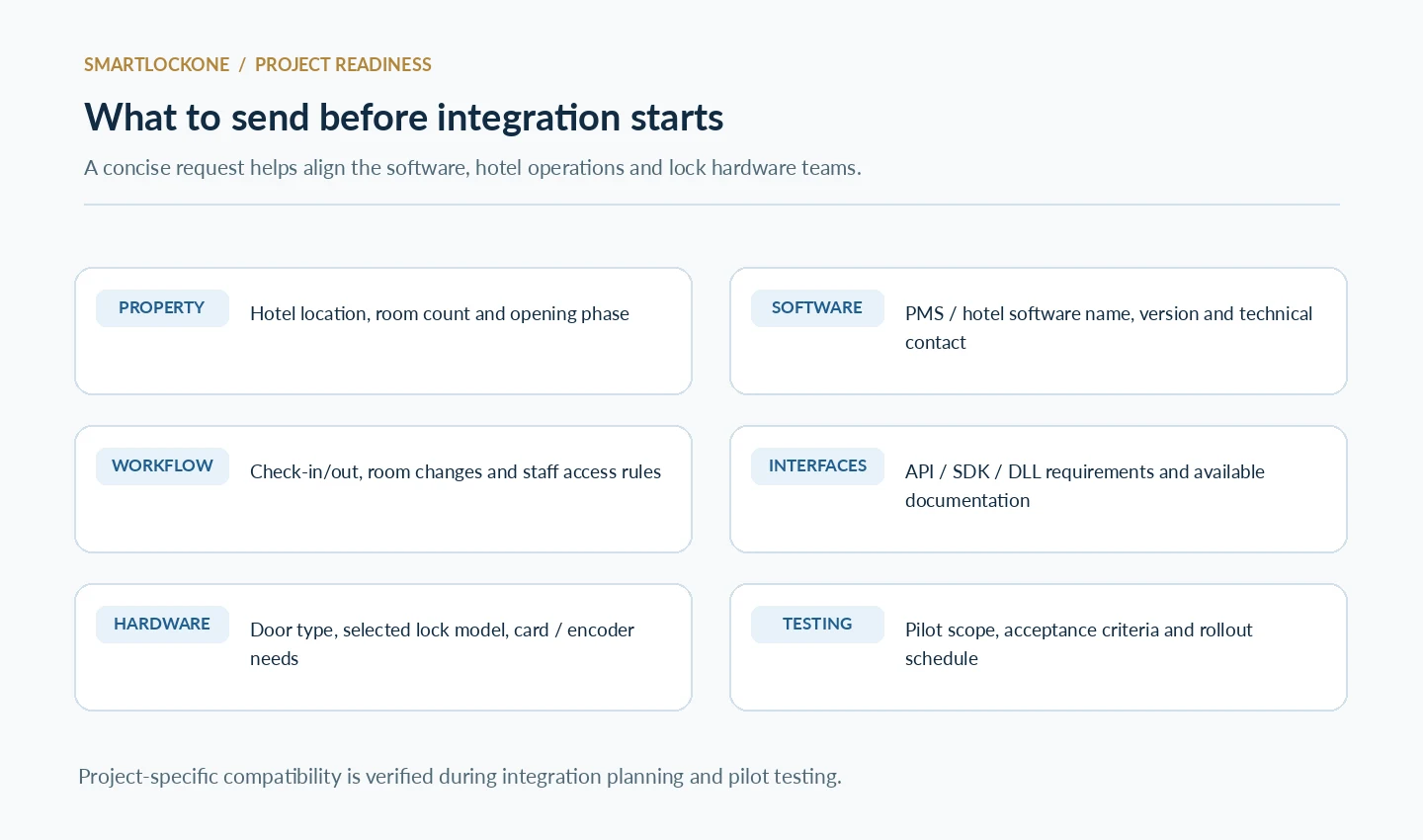
For a faster technical review, share the following details in one project enquiry:
- Hotel: country, property type, number of rooms and expected installation schedule.
- Software: existing PMS/hotel software name, version, deployment environment and technical contact.
- Workflows: check-in/check-out, room changes, keycard issuing, staff access and other required actions.
- Integration: whether your software team prefers an API, SDK or DLL interface and any available software documentation.
- Hardware: door type and thickness, existing lock photos, selected model if known, and required card/encoder components.
- Testing: planned pilot scope, acceptance criteria and procurement schedule.
SmartLockOne can provide hotel lock management software as well as API, SDK and DLL interface materials for integration projects. To review your existing PMS and hotel lock requirements, contact SmartLockOne with your project details and request the relevant integration documentation.
Frequently asked questions
SmartLockOne supports integration with existing hotel software or PMS and can provide API, SDK and DLL materials. The integration method, supported workflows and deployment are confirmed using the customer’s software environment and project requirements.
Yes. SmartLockOne can provide hotel lock management software as part of a hotel lock system proposal. The exact software and hardware configuration should be specified for the selected project.
No. Integration capability does not mean every PMS version, feature or configuration works without development or testing. Share the software name, version and required workflow for a project-specific technical review.
Yes. SmartLockOne can provide the relevant interface materials directly to customers. Include the project background and technical contact so the appropriate materials can be selected.
Not necessarily. Projects can assess connecting the existing PMS or hotel software to the hotel lock system. Whether the existing software can remain unchanged depends on its interface capabilities and the agreed implementation plan.
Do not assume so. Credential technology, card encoding and management workflows must match the selected system. Confirm the existing card and encoder setup during the project review.
Test representative doors, the selected credentials and encoders, the intended integration actions, exception scenarios and front-desk procedures. Document pilot results before authorizing a wider rollout.