
Choosing hotel smart locks for a GCC project is not only a question of choosing RFID or keypad access. A lock may have the right functions and still be unsuitable for the actual door, the existing mortise, the operating workflow, or the selected hotel system.
For hotel owners, developers, procurement teams, ELV integrators and hospitality suppliers, the safest buying process is to confirm the physical door conditions first, then define the access method, management requirements, sample plan and project-supply scope.
This guide explains the information a buyer should prepare before requesting a hotel smart lock quotation from SmartLockOne.
1. Start With the Door, Not the Feature List
A common procurement mistake is to compare lock features before confirming whether the lock can be installed on the actual door.
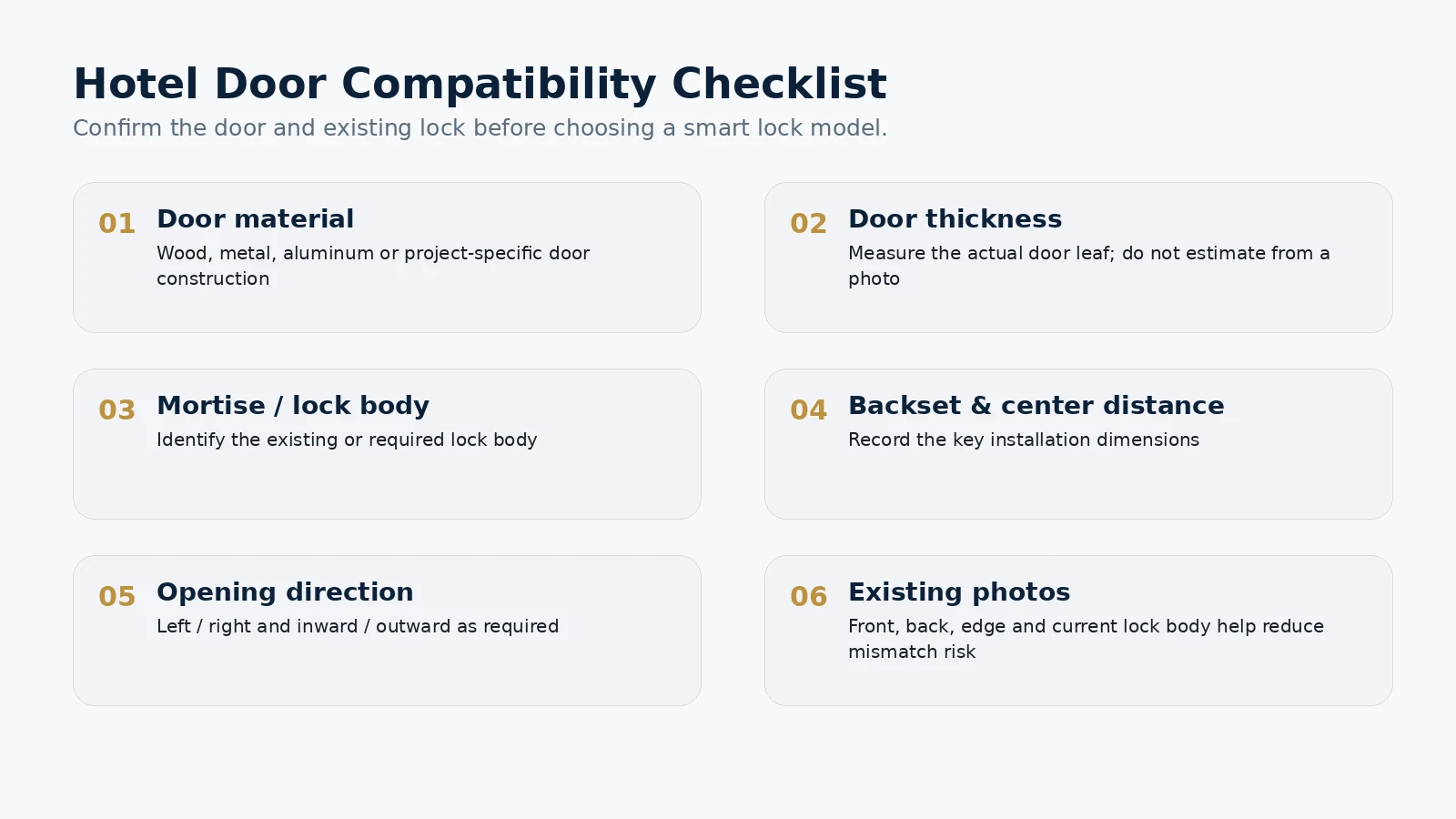
Before a supplier recommends a model, collect the following information for each main door type in the project:
- Door material
- Door thickness
- Existing lock body or mortise
- Backset
- Center distance
- Door opening direction
- Front, back and edge photos of the current door and lock
- Whether the project is a new installation or replacement
For replacement projects, the existing mortise and drilling position are especially important. A new smart lock should not be selected only from a front-view photo.
If a hotel has several door types, group them before requesting a quotation. Guest rooms, service areas and other controlled doors may not use the same hardware.
2. RFID or Keypad: Choose Based on the Operating Workflow
Both RFID and keypad hotel locks can be relevant to hospitality projects, but the correct choice depends on how the property intends to manage guest access.
RFID hotel locks
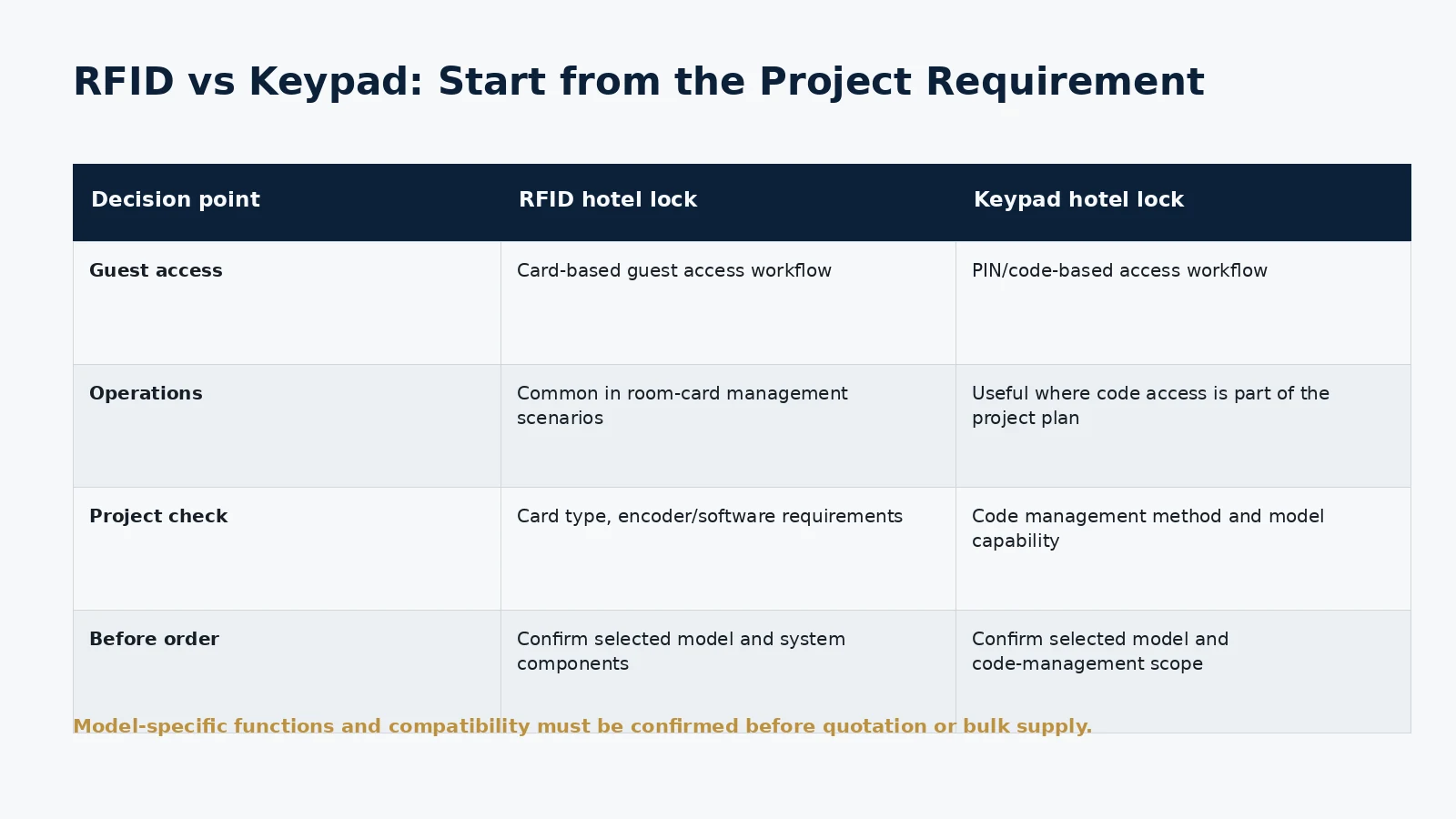
RFID locks are commonly considered when the hotel wants a card-based guest-access workflow. The buyer should still confirm the selected card type, the required encoder or management components, and whether the chosen lock belongs to the same approved system.
The important question is not simply “Does this lock support RFID?” It is “Which card, which lock model and which management workflow will be used in this project?”
Keypad hotel locks
Keypad locks may be useful when PIN or code access is part of the project requirement. Before ordering, the buyer should confirm how codes are created, changed and managed for the selected model.
A keypad on the front panel does not automatically define the complete operating method. Code-management capability must be confirmed at model level.
3. Confirm Door Thickness, Mortise, Backset and Center Distance
Physical compatibility is one of the most important parts of a hotel lock quotation.
A supplier should not assume that every hotel door uses the same mortise. Before sample approval, confirm:
Door thickness
Measure the actual door leaf. Do not estimate thickness from a photograph.
Mortise or lock body
Identify the current lock body for replacement projects, or provide the required mortise specification for a new project.
Backset
Backset is the distance from the door edge to the relevant lock centerline. The required value depends on the selected lock and mortise.
Center distance
If the project has an existing handle/cylinder layout, measure the relevant center distance and provide photos or drawings.
SmartLockOne should evaluate these dimensions against the selected model before confirming compatibility. When dimensions are still unknown, the quotation should remain conditional rather than presenting the model as a guaranteed fit.
4. A Hotel Lock Project Can Use SmartLockOne Software or Integrate With the Hotel's Existing System
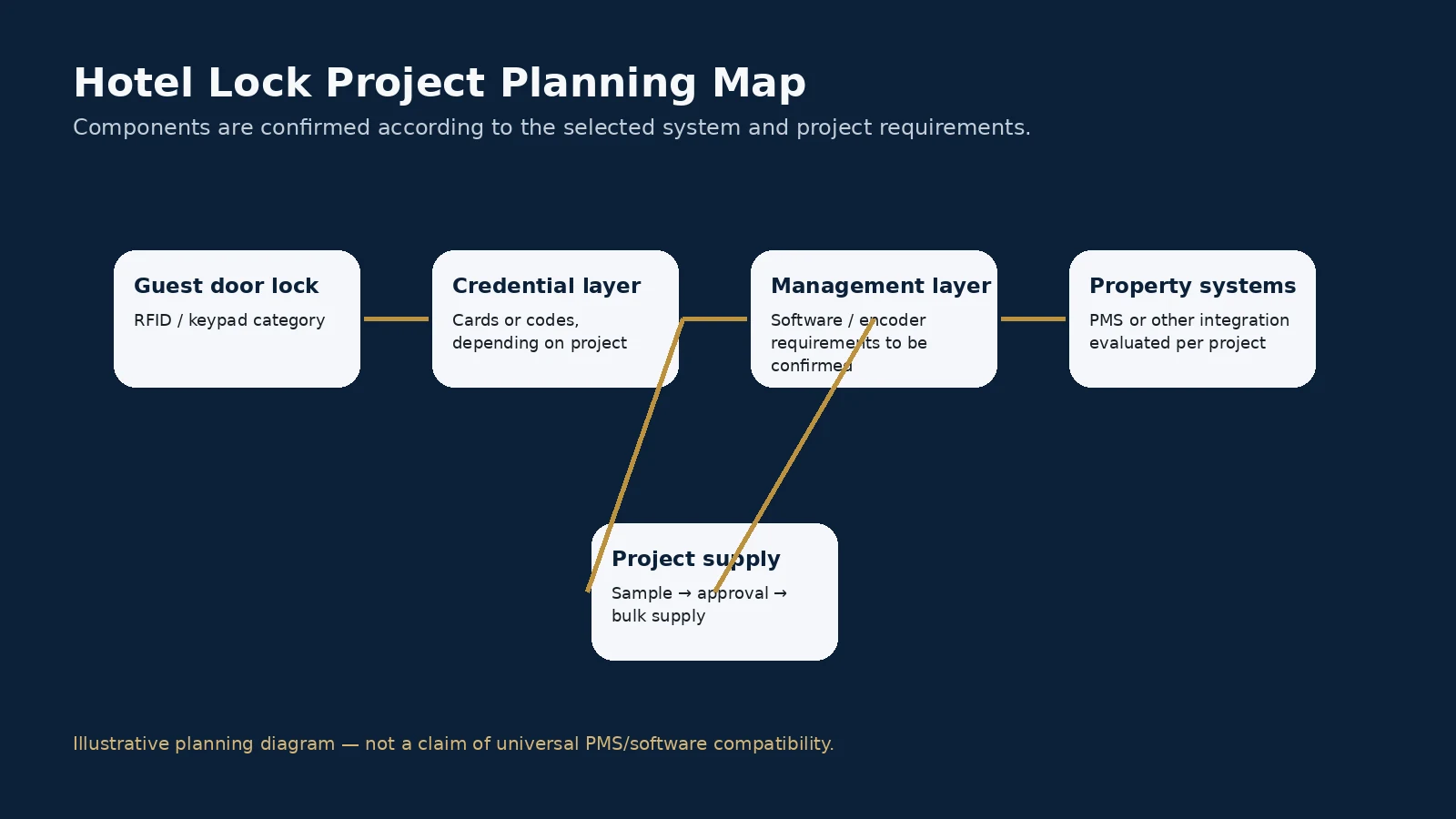
A hotel lock project may involve more than the door lock itself.
Depending on the project, SmartLockOne can provide a complete hotel lock management solution including the lock system and hotel lock management software.
If the hotel already uses its own hotel software or PMS, SmartLockOne can provide API, SDK and DLL interface materials so the hotel lock system can be integrated with the customer's existing software environment.
Typical project components may include:
- Hotel RFID or keypad locks
- Guest credentials such as RFID cards or codes
- Card encoder requirements
- SmartLockOne hotel lock management software
- API / SDK / DLL integration materials
- Staff access workflow
- Spare locks, cards and related accessories
This gives hotel buyers two practical routes:
- Use SmartLockOne's hotel lock management software as part of the project.
- Integrate the SmartLockOne hotel lock system with the hotel's existing software or PMS through API, SDK or DLL interface materials.
For hotel and resort projects, buyers can review the SmartLockOne Hotels & Resorts Solution for the broader system scope.
5. SmartLockOne Supports Universal PMS Integration
SmartLockOne hotel lock systems support universal PMS integration.
For hotels that already operate their own software or PMS, SmartLockOne can provide API, SDK and DLL interface materials directly to the customer for technical integration.
The exact implementation method still depends on the customer's software environment, including:
- PMS or hotel software name and version
- Required check-in / check-out workflow
- Interface configuration
- Software deployment method
- Required data exchange
- New-installation or retrofit project structure
The integration capability itself is supported. Project-specific work focuses on configuring the connection correctly for the customer's existing system.
6. Confirm the Project Scale Before Selecting the Supply Plan
A 10-room boutique property and a multi-building hotel project do not have the same procurement process.
Before quotation, provide:
- Number of guest-room doors
- Other controlled doors, if included
- Number of buildings or phases
- Sample quantity
- Expected bulk quantity
- Target delivery schedule
- Whether the project will be delivered in one shipment or stages
Project scale can affect sampling, packaging, spare quantities, production planning and the level of system coordination required.
7. Use Sample Testing Before Bulk Supply
For a new model, replacement project or unfamiliar door specification, sample testing reduces installation and compatibility risk.
A practical process is:
- Confirm the main door dimensions and project requirement.
- Select one or more candidate models.
- Prepare a sample order.
- Test the sample on the actual project door or a representative door.
- Confirm installation, access method and required system components.
- Approve the final model before bulk production.
Sample approval is particularly important where an existing lock body must be replaced.
8. OEM and Project Supply Should Be Defined Separately
SmartLockOne supports B2B project supply and company-level OEM/ODM cooperation, but OEM capability should not be assumed to apply in exactly the same way to every model.
If your project needs private-label supply, discuss the required scope separately, such as:
- Logo or brand presentation
- Packaging requirements
- Product finish options
- Documentation
- Order quantity
- Production schedule
The available customization scope should be confirmed against the selected product and order requirement before it is included in the quotation.
For company-level information, see SmartLockOne OEM & ODM.
9. Prepare a Complete RFQ Package
A detailed RFQ allows a supplier to evaluate the project more accurately and reduces repeated clarification.
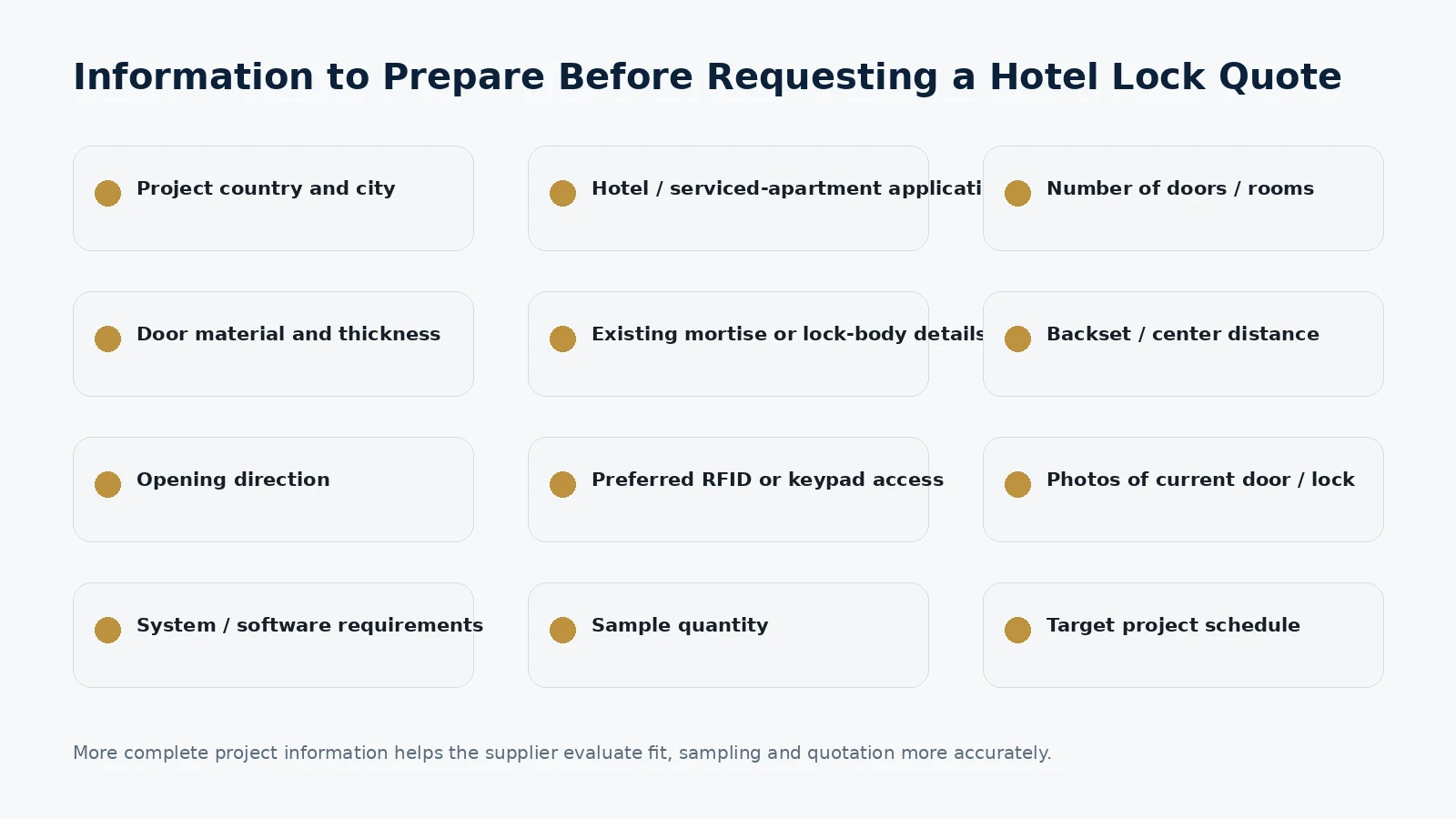
Before requesting a quotation, prepare:
- Project country and city
- Property type
- Number of rooms or controlled doors
- Door material
- Door thickness
- Mortise or existing lock-body information
- Backset and center distance
- Opening direction
- Preferred access method
- Photos of the current door and lock
- Software or system requirements
- Sample quantity
- Expected bulk quantity
- Target project schedule
If some information is not yet available, identify it as pending rather than estimating it.
10. Build the Buying Process Around Verification
A reliable hotel smart lock procurement process should move from requirement confirmation to sample approval and then to bulk supply.
For GCC buyers, the core questions are the same whether the project is in Saudi Arabia, the UAE, Qatar, Kuwait, Oman or Bahrain:
- Will the lock physically fit the door?
- Is the access method appropriate for the operating workflow?
- Are the required software and accessories part of the selected system?
- Has any external integration been checked rather than assumed?
- Has the sample been tested before bulk supply?
- Are the final product, quantity and customization requirements documented?
A buying process built around these questions is more useful than selecting a lock only because it has a long feature list.
Frequently Asked Questions
What information should I send before asking for a hotel smart lock quotation?
Send the project location, number of doors, door material and thickness, existing mortise or lock-body details, backset, center distance, opening direction, access preference, door photos and any software or integration requirements. If the project is a replacement, photos of the existing lock and door edge are particularly useful.
Should a hotel choose RFID or keypad locks?
The decision depends on the property's guest-access workflow and the selected lock system. RFID is relevant to card-based workflows, while keypad models may suit projects where code access is required. The final choice should also consider door compatibility and management requirements.
Can SmartLockOne hotel lock systems integrate with PMS?
Yes. SmartLockOne hotel lock systems support universal PMS integration. SmartLockOne can provide hotel lock management software, or provide API, SDK and DLL interface materials directly to customers who want to integrate the lock system with their existing hotel software or PMS. The exact configuration is confirmed according to the customer's software environment and project workflow.
Do I need to confirm the mortise before ordering?
Yes. For both replacement and new-installation projects, the mortise or lock-body requirement is an important part of compatibility. Provide the existing mortise information or required dimensions before final model approval.
Should I test a sample before placing a bulk order?
Sample testing is recommended when the door specification, mortise, installation condition or selected model has not already been approved for the project. It allows the buyer to verify physical fit and the required access workflow before bulk supply.
Does SmartLockOne provide OEM/ODM service for hotel locks?
SmartLockOne supports company-level OEM/ODM and B2B project cooperation. The actual customization scope, order requirement and availability should be confirmed for the selected product rather than assumed for every model.
Next Step
For hotel and resort projects, review the SmartLockOne Hotel Smart Lock Solution and the Hotel RFID Lock category.
If you are preparing a quotation or sample request, contact SmartLockOne with the door information and project requirements listed in this guide.